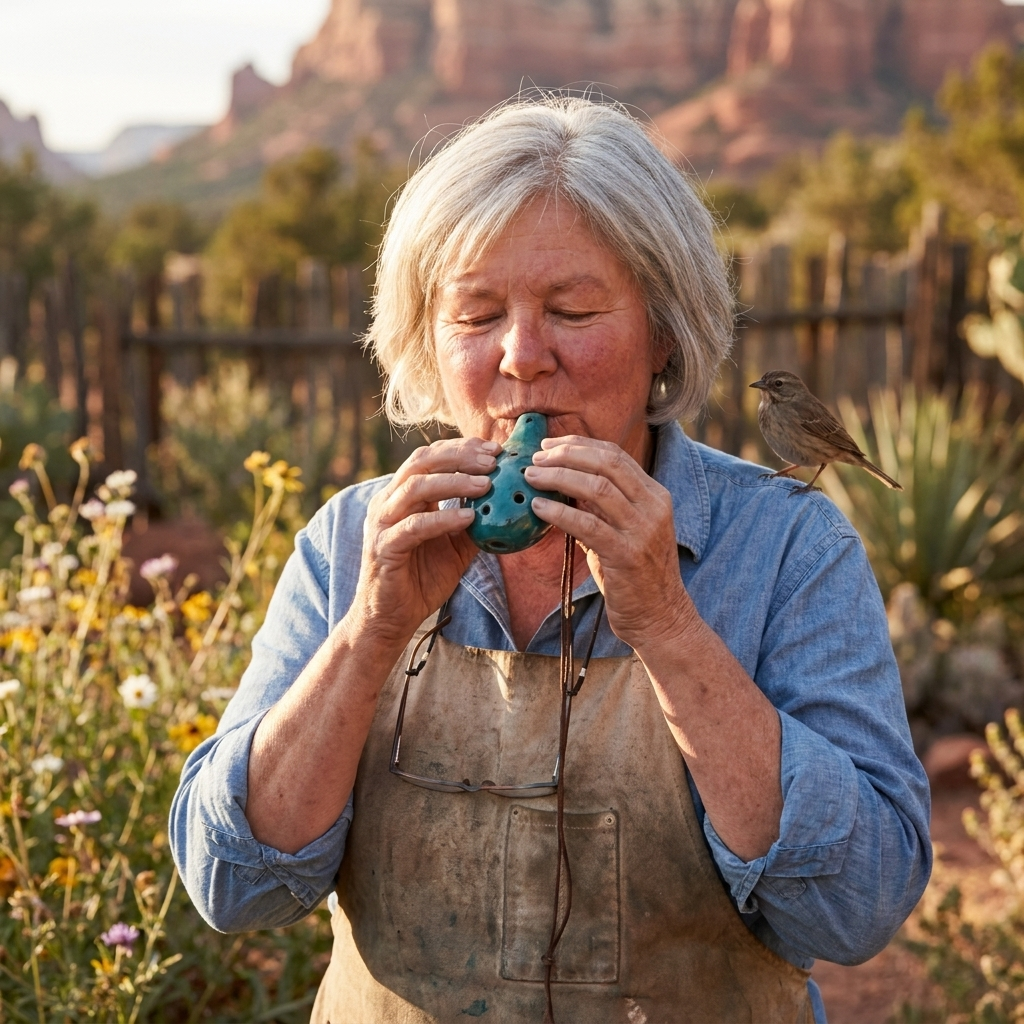
Margaret's Handcrafted Ocarina Flute
Margaret's Handcrafted Ocarina Flute
Solid untreated cedar — naturally weather-resistant, no varnish, no chemicals
Copper roof — keeps the rain out and ages into a beautiful patina
Mixed tunnel sizes — welcomes mason bees, mining bees and many other wild species
Couldn't load pickup availability

Margaret's Handcrafted Ocarina Flute
Shaped by Hand in Sedona, Arizona
Margaret Hayes, 64. Retired music teacher. Throws ceramic ocarinas in a sixteen-square-meter wooden shed behind her cabin at Oak Creek. Each one is tuned to answer the canyon wrens outside her window.
"I spent thirty years teaching children to listen. When I retired, I sat on my porch and heard the wrens for the first time. The ocarina is my way of talking back."
— Margaret Hayes, Oak Creek, Arizona
What’s in the Box
Everything Margaret Sends With the Ocarina
The Ocarina
One hand-thrown ceramic ocarina with six finger holes, glazed and kiln-fired in Margaret’s shed.
Adjustable Cord Necklace
Waxed leather cord, adjustable length. Wear it, carry it, keep it close.
Why This Ocarina
Six Things You Won’t Find on a Factory Ocarina
Every detail below comes from thirty years of teaching music and four years of shaping clay next to a creek full of songbirds. Nothing here is accidental.
The Songbird Frequency
Margaret tunes every ocarina into the high-register range where canyon wrens and house finches sing. She noticed it in the first year: play the ocarina on the porch, and the birds answer. Not a guarantee — a pattern. The wrens seem to think it’s one of them.
The Ergonomic Teardrop
The teardrop shape is not decorative. Margaret throws each ocarina to sit in a cupped hand with all six holes reachable without stretching. Every edge is rounded in the kiln. No sharp ridges, no cramped fingers, even after twenty minutes of playing.
The Tuned Mouthpiece
The blow hole is angled and shaped so the air column stays even across all six notes. This is where factory ocarinas fail — they either shriek or whisper. Margaret’s mouthpiece sits at the angle where every note comes out full and round, without forcing.
The Pocket Format
6.2 centimeters tall, 4.2 wide. Fits in a coat pocket, a tote bag, a child’s hand. Margaret wanted an instrument that goes where you go. On a trail. On a balcony. In a garden at dusk when the birds are loudest.
The Living Glaze
Each ocarina is hand-glazed before it enters the kiln. The colors shift and crackle unpredictably in the heat — no two ocarinas come out the same. The speckles, the drips, the color breaks are the kiln’s signature, not flaws.
The Six-Hole Simplicity
Six holes. Six notes. Every note works with every other. Margaret chose this layout because it’s the one her youngest students learned fastest — and the one the wrens responded to most. No music theory required. Cover the holes, blow gently, listen.
— Expert Note
“The ceramic ocarina is one of the oldest wind instruments on earth — versions of it exist in nearly every culture going back thousands of years. What makes a hand-tuned ocarina different from a mass-produced one is the voicing: the precise shaping of the air channel that determines whether a note sings or squeaks. Getting that right by hand, consistently, across dozens of instruments, is genuinely difficult work. The fact that songbirds respond to certain ocarinas is well-documented in field recordings — the frequency overlap between a small ceramic ocarina and passerine birdsong is real, not folklore.”
Dr. Helen Whitaker — Professor of Music Education, Northern Arizona University, Flagstaff
Where It Lives
Perfect For
Quality Promise
Five Things You Get With Every Ocarina
30-Day Return Policy
If the ocarina doesn’t feel right in your hands, send it back within 30 days for a full refund. No questions, no forms, no return-shipping cost. Just an email to our team.
A Note From the Workshop
Margaret shapes every ocarina on the same wheel she has used since 2022. Slight variations in glaze, color, and pitch are part of how each instrument finds its voice. The kiln decides the final color. The creek air decides the final tone. These are not flaws — they are the maker’s hand and the canyon’s breath at work.
The Details
Product Specifications
| Material | Kiln-Fired Ceramic |
| Finish | Hand-Glazed, unique color per piece (Blue, Teal, Yellow, Red available) |
| Dimensions | 6.2 cm × 4.2 cm (2.4″ × 1.65″) |
| Notes | 6 finger holes, pentatonic voicing, songbird register |
| Set Includes | Ceramic ocarina + adjustable waxed leather cord necklace |
| Play Method | Blow gently into mouthpiece, cover holes with fingertips |
| Care | Wipe with a soft dry cloth. Do not submerge. |
| Origin | Hand-thrown in Sedona, Arizona |
| Maker | Margaret Hayes, retired music teacher, West Sedona Junior High (1990–2020) |
| Sound Character | Warm, clear, high-register — overlaps with passerine birdsong frequencies |