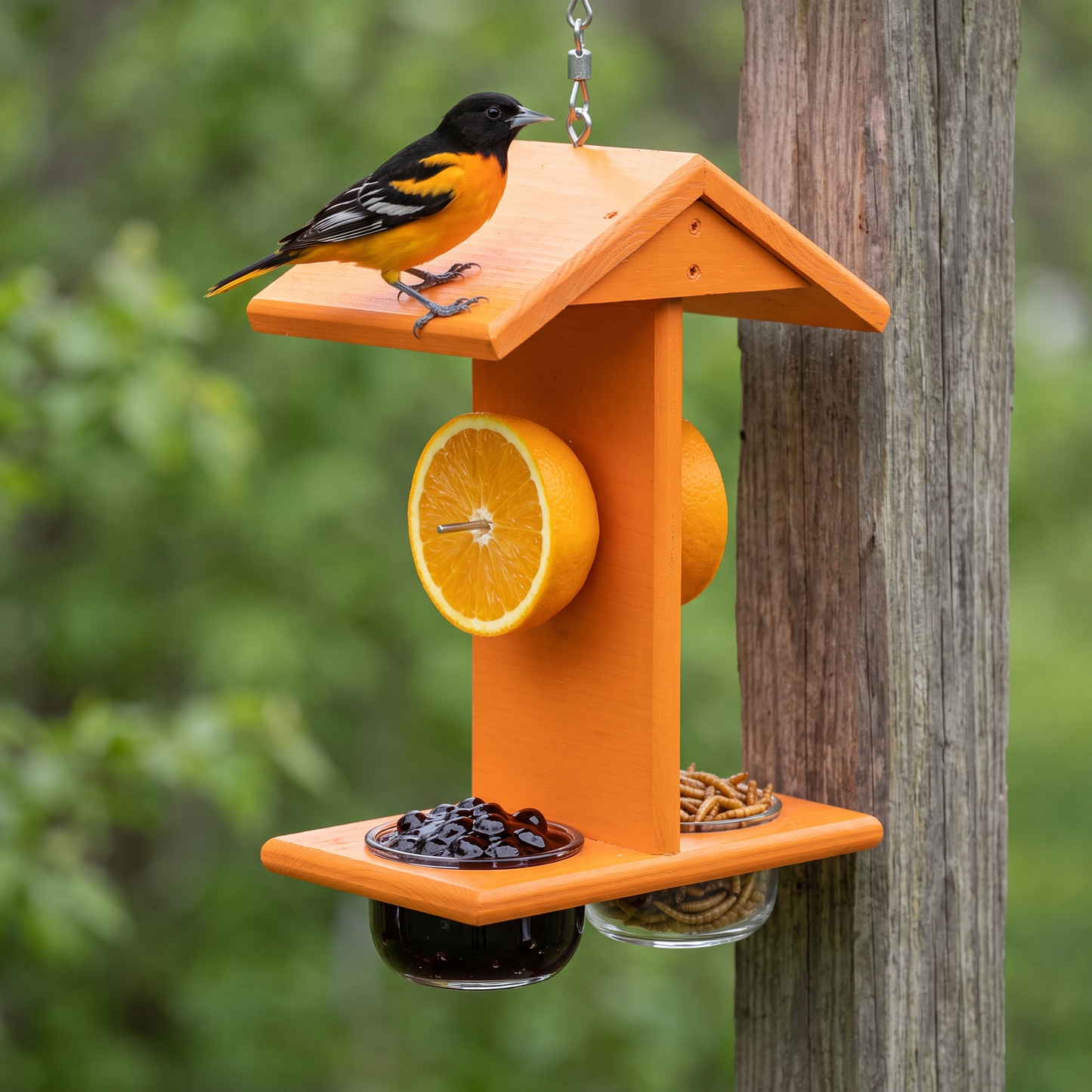
Earl's Hand-Built Oriole Feeder
Earl's Hand-Built Oriole Feeder
Solid untreated cedar — naturally weather-resistant, no varnish, no chemicals
Copper roof — keeps the rain out and ages into a beautiful patina
Mixed tunnel sizes — welcomes mason bees, mining bees and many other wild species
Couldn't load pickup availability

Earl's Hand-Built Oriole Feeder
Hand-Built for the One Bird Nobody Feeds
Earl Sorenson, 84, has watched Baltimore orioles come up the Mississippi valley for fifty springs from his woodshop in Coon Valley, Wisconsin. This is his last batch — built by hand, one at a time.
“People swear the orioles left their town. They didn’t. The feeder just told them to keep flying. It isn’t the yard and it isn’t the food — it’s a color and a roof, and almost every feeder gets both wrong.”
— Earl Sorenson, Coon Valley, Wisconsin
The Feeder
Solid wood, roofed, finished in true oriole orange.
Orange Spike
Center post holds a fresh orange half.
Two Jelly Cups
Lift-out cups for grape jelly and fruit.
Hanging Chain
Ready to hang straight from the box.
The Orange That Calls Them In
Orioles hunt by color. The true oriole-orange body reads from the treetops — it’s not decoration, it’s the lure.
The Dry-Larder Roof
A pitched roof shades the orange and jelly and keeps rain off, so the food stays worth landing on all day — even in July heat.
The Full Table
Orange spike, two jelly cups, and dishes for mealworms and fruit — the whole oriole diet at one station, built for the whole family.
The Lift-Out Cups
Cups pull straight out and rinse clean in seconds. The feeder that can’t be cleaned is the one that never is.
The Open-Sky Hang
Hangs on a chain out in the open, up off the ground where an oriole scanning from above will find it — and cats won’t.
The Solid-Wood Body
Real wood, not thin plastic that warps and fades. It holds its color and shape through a full season in the sun.
“The two things that decide whether a yard gets orioles are visibility and food quality — and both come down to the feeder. A strong orange cue pulls them in from distance, and a roof is what keeps oranges and jelly from spoiling in summer heat. A well-built roofed feeder like this addresses the exact failure points I see in backyard setups.”
Dr. Rachel Downing
Ornithologist, Upper Mississippi Bird Observatory
- Solid wood construction — no thin plastic that warps or fades by midsummer.
- True oriole-orange finish — the color the bird is built to look for.
- Weather roof — shades and shelters the food through sun and rain.
- Removable cups — rinse clean in seconds, season after season.
- Ready to hang — chain included, up in minutes.
30-Day Backyard Guarantee
Hang it, give the orioles a week or two to find it, and see for yourself. If it isn’t everything you hoped, send it back within 30 days for a full refund — just an email, no questions asked.
A note on handmade
Each feeder is built and finished by hand, so no two are exactly alike — small variations in grain and finish are the mark of the maker, not a flaw. Add a fresh orange half and a spoon of grape jelly, hang it out in the open, and give the birds a little time to find it.
| Material | Solid wood, weather-finished |
| Finish | True oriole-orange, roofed |
| Includes | Feeder, center orange spike, two lift-out jelly cups, hanging chain |
| Feeds | Orange halves, grape jelly, mealworms, cut fruit |
| Dimensions | Approx. 9 x 8 x 8 in (23 x 20 x 20 cm) |
| Color | Oriole Orange |
| Mounting | Hangs by chain (included) |
| Care | Lift out cups, rinse; wipe down as needed |
| Made | Hand-built, one at a time — final batch |
| Best season | Spring through late summer (oriole season) |