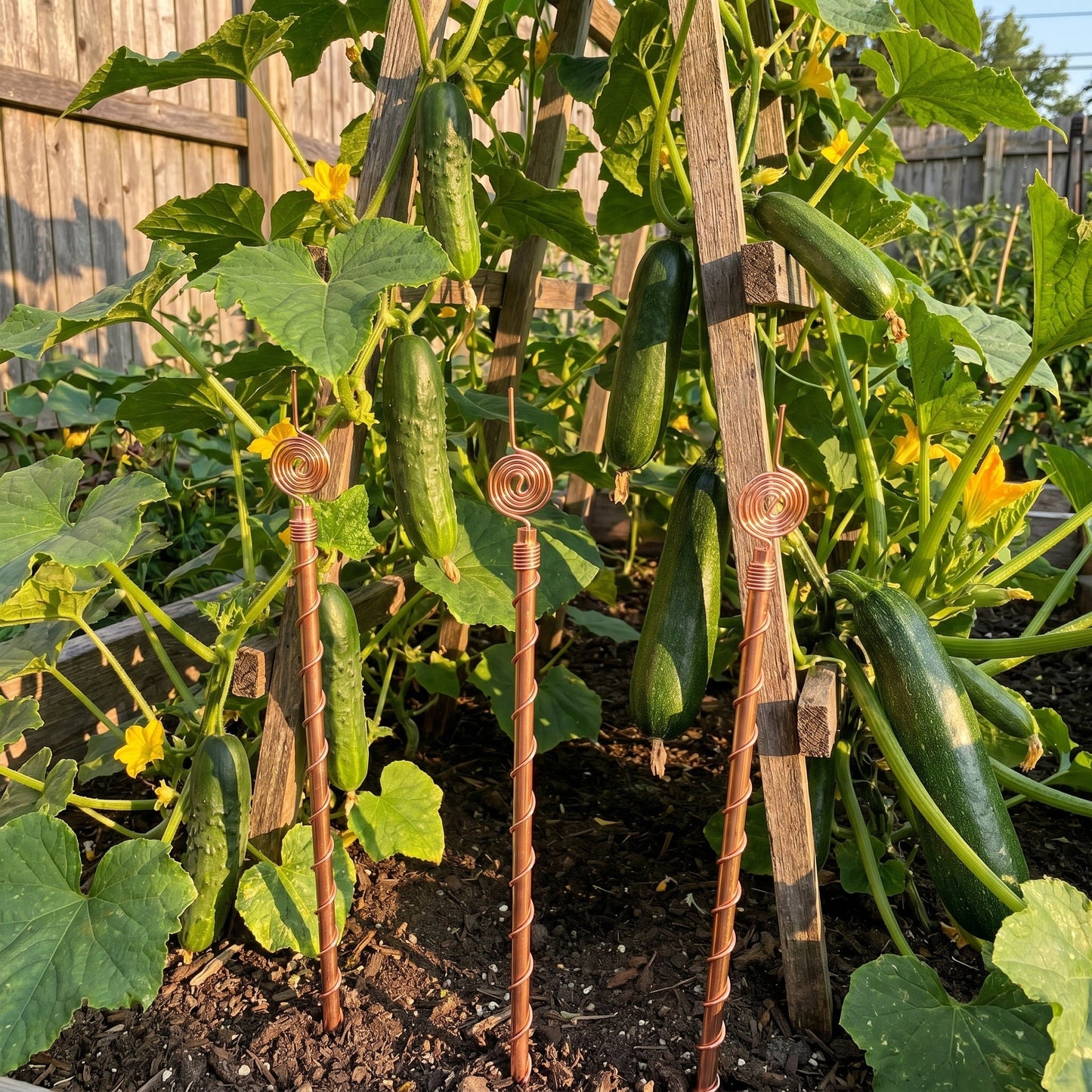
Henri's Plant-Boosting Copper Garden Stakes (Set of 3)
Henri's Plant-Boosting Copper Garden Stakes (Set of 3)
Solid untreated cedar — naturally weather-resistant, no varnish, no chemicals
Copper roof — keeps the rain out and ages into a beautiful patina
Mixed tunnel sizes — welcomes mason bees, mining bees and many other wild species
Couldn't load pickup availability

Henri's Plant-Boosting Copper Garden Stakes (Set of 3)
Brossard Hand-Wound Copper Garden Stakes
Hand-wound by Henri Brossard, 78, in his West Asheville workshop — on the same walnut-wood mandrel his grandfather hand-turned in the Vendée in 1921.
“I don’t want my grandfather’s stakes in a collector’s display case. I want them in a tomato bed. I want them where someone will look at them in twenty years and remember the old man who made them.” — Henri Brossard, West Asheville NC
What’s in the Set
- 3 hand-wound copper stakes — 32 cm each, slightly unique
- 1 hand-written card signed by Henri with planting notes from the 1921 notebook
- Brown paper & twine packaging — no plastic, reusable
- Workshop phone line — Henri answers planting questions 3 days a week
What Makes Each Stake
The 1921 Mandrel Method
Every Lakhovsky coil is wound on the same walnut-wood mandrel Henri’s grandfather hand-turned in the Vendée in 1921. Over a century of copper has worn eight shallow grooves into the walnut.
99.9% Pure Copper
No brass, no alloy, no plating. Agricultural-grade copper drawn in small batches from a single Pennsylvania mill. Develops the traditional Vendée verdigris patina in its first season.
The Three-Element Antenna
Each stake combines three structures drawn from the 1921 notebook: the flat Lakhovsky spiral coil head, the dense ring-binding below it, and the helix wrap that descends to the soil tip.
The 32-cm Garden Standard
Vendée market gardeners observed that a stake between 30–34 cm fits any vegetable row, raised bed, or container without disturbing the root zone. Held to the millimeter.
The Hand-Wind Variance
No two stakes are identical. Each coil carries the micro-signature of Henri’s thumb — pressure, angle, the small hesitation before the final winding. The signature of the method, not a defect.
The Walnut-Polish Finish
Industrial steel mandrels leave microscopic scratches on the inside of a coil. The walnut-wood mandrel burnishes the copper smooth as the wire is drawn against the grain.
“What sets the Brossard stakes apart isn’t the copper alone — it’s the unbroken chain of the method. A 1921 Vendée mandrel, the same family, the same hand-form. In a century of mass-produced garden tools, this kind of provenance is genuinely rare.”
DR. ELEANOR THATCHER Heritage Horticulture Research, Asheville Botanical SocietyQuality Promise
- Hand-wound by Henri Brossard. Every stake passes through his hands.
- Documented Lakhovsky tradition. Form drawn directly from the 1921 French notebook.
- Pure copper, no alloy. 99.9% agricultural-grade from a Pennsylvania mill.
- Made in America. The whole process happens in West Asheville, North Carolina.
- One of the last 400. No more Brossard stakes will be made after this batch.
30-Day Garden Guarantee
If a stake doesn’t feel right in your garden, return it within 30 days for a full refund. No questions, no restocking fee. Henri’s daughter Claire handles the paperwork — just email the workshop and a return label arrives the same day.
Because every stake is wound by hand on a 100-year-old walnut mandrel, no two are identical. You may receive coils with subtle variation in winding tightness, ring-binding alignment, or surface patina — these are the maker’s micro-signatures, not flaws.
Product Details
| Material | 99.9% pure copper (agricultural grade) |
| Finish | Walnut-burnished, untreated — develops natural verdigris patina |
| Set Contents | 3 hand-wound copper stakes, hand-written card, brown paper & twine packaging |
| Stake Length | 32 cm (12.5 inches), held to the millimeter |
| Spiral Coil Diameter | ~5 cm (2 inches), wound on the 1921 walnut mandrel |
| Recommended Use | Raised beds, vegetable rows, food-forest plantings, container gardens |
| Care | No cleaning needed. Rinse with water if soil-caked. Patina is natural. |
| Origin | Hand-wound in West Asheville, North Carolina, USA |
| Tradition | Based on Georges Lakhovsky’s 1921 Vendée gardening notebook |
| Maker | Henri Brossard, 78, retired toolmaker |
| Edition | Final batch — one of the last 400 ever to be wound |