
Big Utility has been robbing American families and getting away with it every time we turn on the AC during summer.
This Arizona engineer is fighting back with his 'Penny AC'.
If you've ever stared at your summer electric bill and felt ripped off, it isn't your fault and it isn't the heat. Read this before you pay another one.

For 12 years, I was the man they sent to cut your power off.
I fixed air conditioners for a living. But some mornings the work order wasn't a repair. It was a disconnect. Drive out, cut the family's power, walk away, and leave them in the heat over an unpaid bill.

The first time, it was an old woman in 115° heat. Her AC was fine. Her bill wasn't. The power company had shut her off from an office three hours away, over one late payment. She could have been my elementary school teacher, my neighbor, my friend's mother. I sat in the truck afterward and couldn't breathe right.
I told myself it must be a mistake. But it wasn't.
It was policy. And this policy killed a 72 year-old woman.

Her name was Stephanie Pullman. The utility cut her power over a $51 debt on a 107-degree day.
She died inside her own home. The medical examiner ruled it heat exposure.
It took her death to force this state to outlaw summer shutoffs.
They will choose a $51 payment over a human life.
That was the day I stopped asking what was wrong with the air conditioners, and started asking who was getting rich.
Why are regulators approving hikes instead of blocking them?
| Year | Rate Hikes | National Avg Electric Bill | What It Meant |
|---|---|---|---|
| 2022 | $4.4 billion | ~$161/mo | Approved: 4.2 million homes shut off |
| 2023 | $9.7 billion | ~$178/mo | Approved: more than double the year before |
| 2024 | $15 billion | ~$181/mo | Requested: regulators grant about 64% |
| 2025 | ~$31 billion | ~$184/mo | Pending Approval: their biggest ask ever |
Rate-hike totals: PowerLines. Average monthly residential electric bill: J.D. Power Quarterly Share of Wallet Tracker.
In 3 years the asks went from $4.4 billion to $31 billion, and the answer keeps being yes.
By 2024, 1 in 6 American households was behind on its electric bill, and that number never came back down.
Here in my own state Arizona, a major utility took home a record $608.8 million. The same year, regulators let it raise rates by 8%. Then it came back for another 14%.
Arizona's Attorney General Kris Mayes put expert testimony on the record: that 14% could be just 3%, and the company would still run fine.

That's $220 a year out of a family's pocket, added to their profit, and not one extra weekend of AC.
You can't call me crazy if I think regulators and utilities are in bed together.
My community is suffering. I had to do something about this. Fast.
Of all the summers to ignore a rate hike, this is the worst one.
AI data centers are already hammering the grid. NIMBY.
Forecasters are warning of a "super" El Niño and one of the hottest years on record. The heat is expected to hold all the way into September.

More demand, more heat, same grid, and their biggest rate ask ever ($31 billion) is pending approval right now.
The usual answers don't land this summer, either. I watched my customers try them all: solar quotes that start at five figures, insulation that can't go in till fall, a couple of towels soaked in ice water, good for about an hour.
What every one of those families needed was something cheap that cools this summer. Here's my second confession: it's been running in my house for years.
My house hasn't needed the AC this summer. It hasn't for years.
At my house, the central unit sits quiet during on-peak hours. What runs instead is a 5-gallon Evaporative Cooler (EC). A "swamp cooler," as everyone out here calls them.

A machine like that doesn't make anybody rich. No compressor to replace, no freon to top up, no $10,000 install, and barely anything for the meter to count.
Here's how coolers are supposed to work: hot air passes through a wet pad, the water in the pad evaporates and takes the heat out of the air, and cool air comes out the other side.

It's not a secret. Homeowners have been posting the savings on contractor forums for decades: "$20 a month to cool a house that would run $160 with conventional A/C."

So why doesn't every house in the US run one? It's the size of a dresser and can't fit in most bedrooms.
But that all changed when the little ones showed up.
But before you buy a cheap Chinese cooler off Facebook or Walmart, I bought them all first.
Last spring they were suddenly everywhere: "personal air coolers," about $30, promising swamp cooler physics in the size of a toaster. If they were real, every hot bedroom in the US should get one.
I had to find out.

The Walmart shelf ran them under names like "Arctic Air". The entire EC selection was 3.5 stars all the way down.
If you ask me, 3.5 stars doesn't sound like "Arctic"-level cooling.
The one big $93 5-gallon unit is the same class as mine. But it was the little ones I'd come for, so I bought every one I could find.
While the boxes piled up, I checked what these things cost out of China's Amazon, and what do you know: similar coolers sit on AliExpress starting at $6.12.

The part that actually does the cooling is the internal pad. The pad my cabinet at home eats a set every season. And the cheapest real replacement pads I could find were $31.95 for a pack of 4. Call it $8 a pad.

Now hold that against the $6.12 cooler. How can the whole cooler cost less than one honest pad?
Suddenly those 3.5 stars at Walmart made sense. It's a $30 Chinese cooler with a cheap pad and a big markup.
That's the part of owning a real EC nobody mentions: the serious machines work, and then it's $8 a pad, season after season. I've paid that bill for years. Worth it, but it's still a bill.
The little $30 ones don't even have replacement pads.
If the pad never cooled anybody, who'd buy a second one?
So the purchase is wasted whether it cost $6 or $26, and the triple-digit electric bill stays the same.
I ran the little ones side by side on my workbench for a month, a thermometer taped in front of each. And just as expected: the cheap coolers barely did anything.
These junk coolers prey on people stuck between brutal heat and an overpriced grid.
So I built my own in my garage.
I pulled a $30 one apart and poured water on the pad. The pad repelled it: water beads like rain on a waxed hood, while most of the pad stayed dry.

A barely-wet pad can't evaporate anything, and no evaporation means no cooling: just a fancy fan blowing over a tank of warm water.
My big cabinet gets away with drowning it in 5 gallons of water. A small box can't. Every drop that beads up is cooling that didn't happen.
After a winter and a trash can full of ruined pads, I discovered a silane-infused colloidal-silica coating that stops water from beading. The water spreads across the whole pad: more wet pad, more evaporation, more cooling.
This coated pad also lasts for multiple summers. No yearly pad replacement required.

The cooler worked. My wife told me it needed a name, so we decided on AiraBreeze.
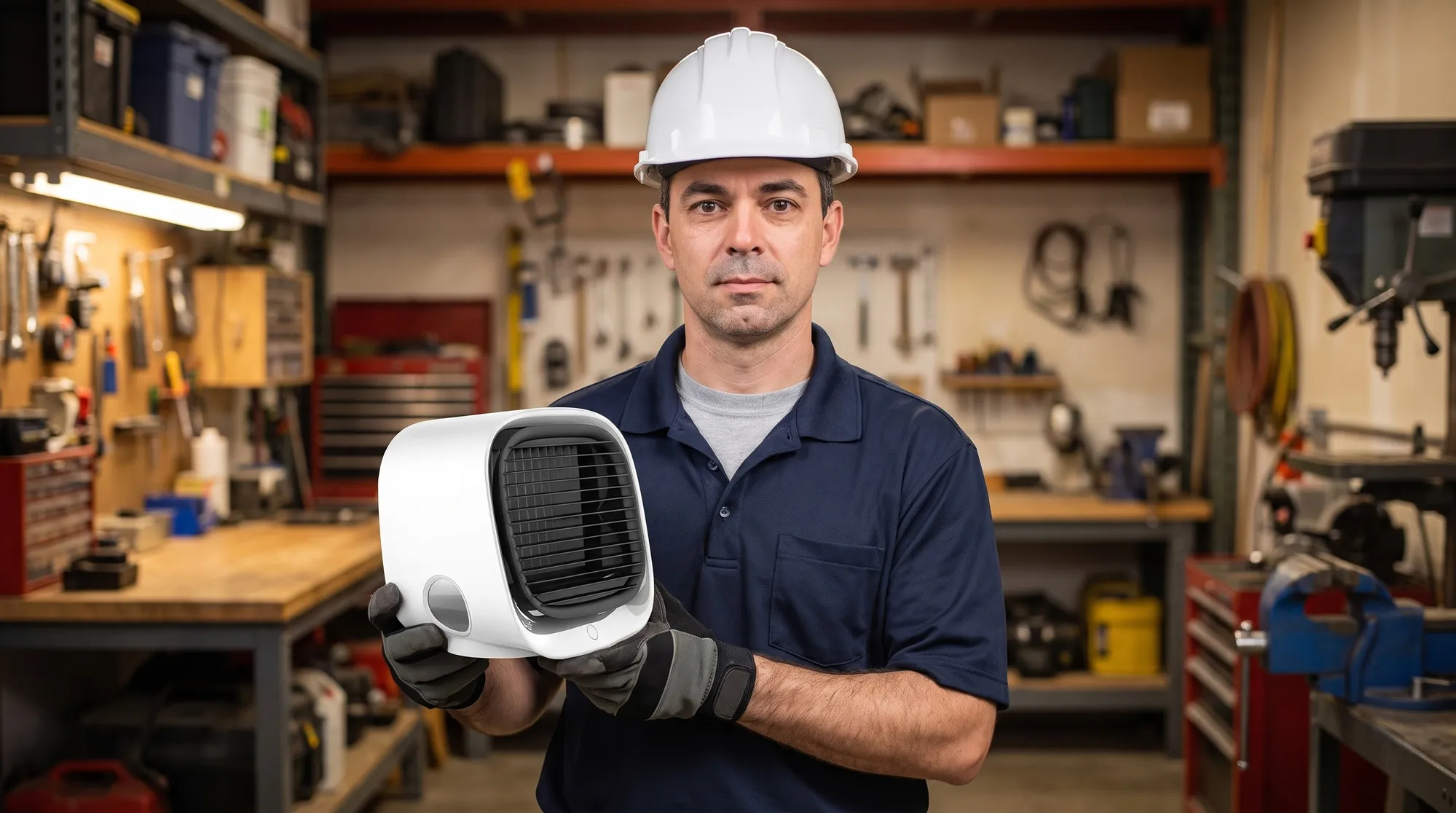
I fixed real air conditioners for a living, so I'll say it once: AiraBreeze doesn't replace AC but it cools the person in the room for pennies. About 65W (one light bulb), against the 3,000-5,000W AC unit. The drier your summer, the faster it cools. Every hour it runs instead of the central unit is an hour the meter barely moves.
I gave out prototypes to all my neighbors and cut their bill the same month. They started telling their friends and soon, everyone was handing me a $100 bill and told me to "keep the change".
Looking at everyone's savings was the best moment of 2026. I knew I did something for my community.
"It literally costs pennies to run", they said.
Half of them don't call it "AiraBreeze" anymore, they just call it "the Penny AC."

Marcus cut my $420 electric bill with his Penny AC and I can't thank him enough. I put a AiraBreeze in my bedroom and stopped the AC after 9pm. The bill came down to $260. That's $160 saved in one month. I bought two more for the living room and my wife's study.
The last 237 pads of the summer.
Every AiraBreeze pad gets the coating by hand, about 100 at a time. It keeps the cost down, and every pad is checked before it leaves my garage.
As I write this, there are 237 cured pads on the shelf. When they're gone, that's it for summer 2026.
This is the last batch I'm curing this season, enough for the families who want one before the worst of the heat lands.
It doesn't eat up floor space. It sits on a desk or nightstand and blows cool air right where someone's trying to sleep.

My neighbors pressed $100 bills on me and told me to keep the change. I'm not the utility; I don't need "record profits". I've still got my day job as an engineer, so the last 237 AiraBreezes are going out at $59.99, less than the 5-gallon cabinet at Walmart.

Others who joined the stand against Big Utility
I'm a night-shift nurse. When I get home at 7am to sleep, running the central AC for hours just for me is insane. The Penny AC cools my bedroom in 20 minutes and it's so quiet! My electric bill dropped by almost $200 last month.
My wife and I sometimes quarrel because of 'temperature preferences'. She freezes on 74°F, but I'm still hot. Now we have one AiraBreeze on each side of the bed, the electric bill dropped $110 last month, and we stopped quarrelling.
I bought one for my mother-in-law in a retirement community where they cap the AC settings in summer, which is crazy. With AiraBreeze, she sleeps through the night, and sends me a text every morning. Definitely worth every dollar.
Marcus's 30-Day Guarantee

On your side against the meter,
Marcus Reyes · AiraBreeze
- Choosing a selection results in a full page refresh.
- Opens in a new window.